WOODCUTS 1990-1998
Online exhibition, 16 October - 28 November, 2026
Ken started making woodcuts in 1979. He taught himself, bought the blocks and tools and printed them in his studio using the back of a spoon. During the 1980s he worked with various fellow artists to deepen his practice but none of the prints were editioned.
When he joined Marlborough in 1989 he met David Case who was the publisher at Marlborough Graphics and with whom Ken was to make 57 editioned prints over the following decade. Ken had recently been introduced to the young art school graduate Jo Briggs, and with the financial support of Marlborough and promise of a show they began working together.
Initially printing some of Ken’s blocks from the 1980s, they went on to make work from new blocks and in eight years produced 12 editions. Some of these have been the most popular prints Ken made, and as a body of work they best demonstrate his understanding and use of colour.
Jo spoke with the author of Ken Kiff, The Complete Prints as he was writing the book, and extracts from her thoughts about some of the works can be found below. She also joined us for the book launch in September 2026 and her vivid memory of working with Ken shed light on his practice and her contribution to this important group of woodcuts.
Most works are for sale, you can purchase through the site by clicking on the images, or contact us here to discuss by email.
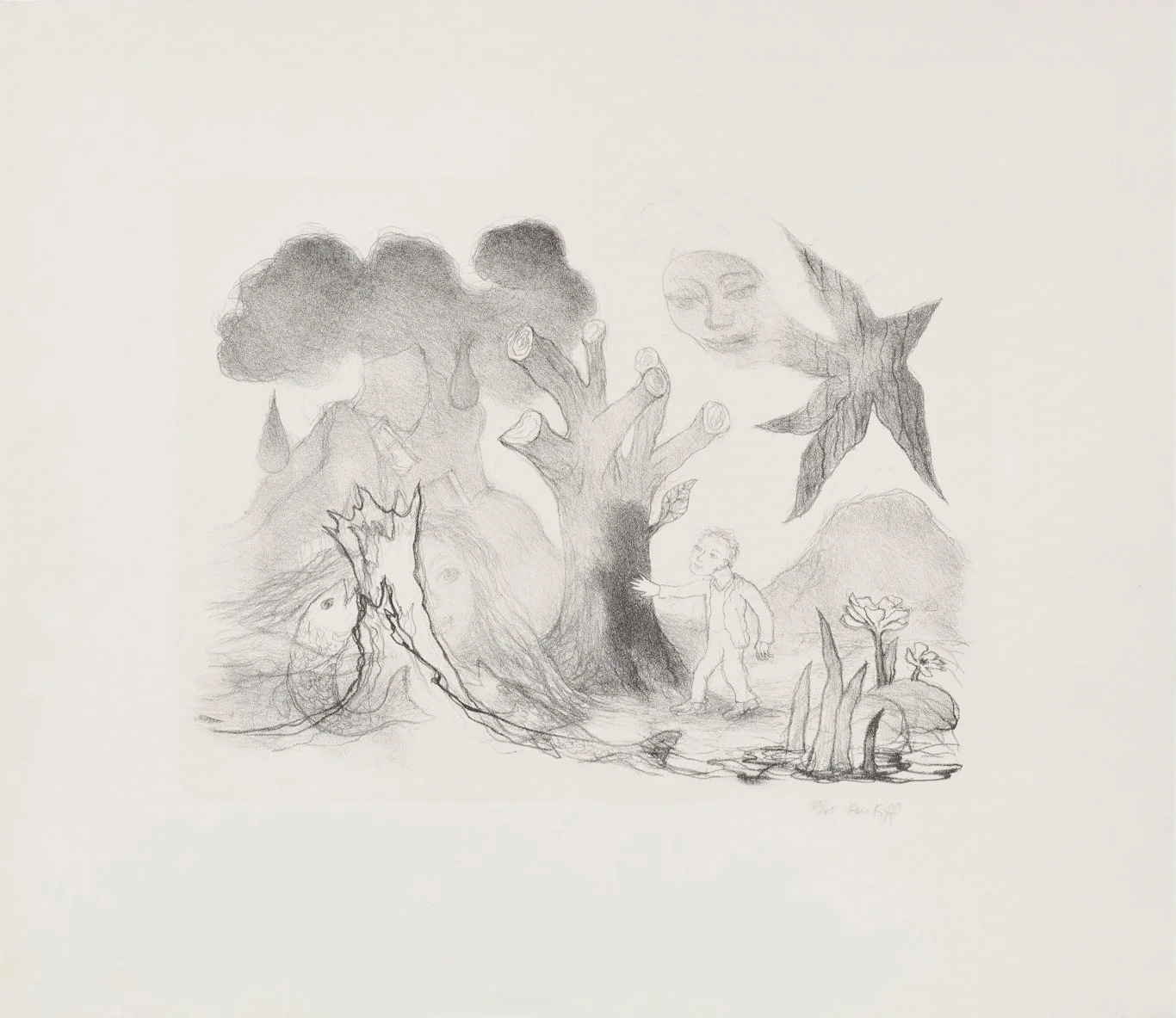
Boy in Street, 1991
lithograph, proofed and printed with Erik Holgersson, Gothenburg
edition of 45 + 10 APs
sheet 52 x 60cm / image 30.3 x 39.5 cm
Lloyd L091.1
“In an entry in his voluminous diaries, Kiff described Boy in Street as ‘one of the best things I’ve done in printmaking’. Of course, no single print can capture the full breadth of his achievements in lithography, etching and woodcut. Nevertheless, Boy in Street demands our particular scrutiny, and not only because Kiff considered it, rightly, an exemplary work. Look… at the figure of the boy - whom we might profitably read as the artist’s avatar - as he places his right hand against the shaded tree trunk. Once we note that this is the densest area of the image, where the grain of the lithographic stone from which it was printed is most clearly in evidence, a new thought occurs. The boy / Kiff is communicating not only with himself (in the form of his cast shadow), and with the exterior world (the wounded, healing tree, whose visible growth rings indicate that it existed long before his birth, and may well outlive him, too), but also with the medium of lithography. More than anywhere else in the print, it is here that the artist demonstrates that he is, as he put it, ‘listening to what […] the stone is saying’.”
£2,500 + vat (unframed)
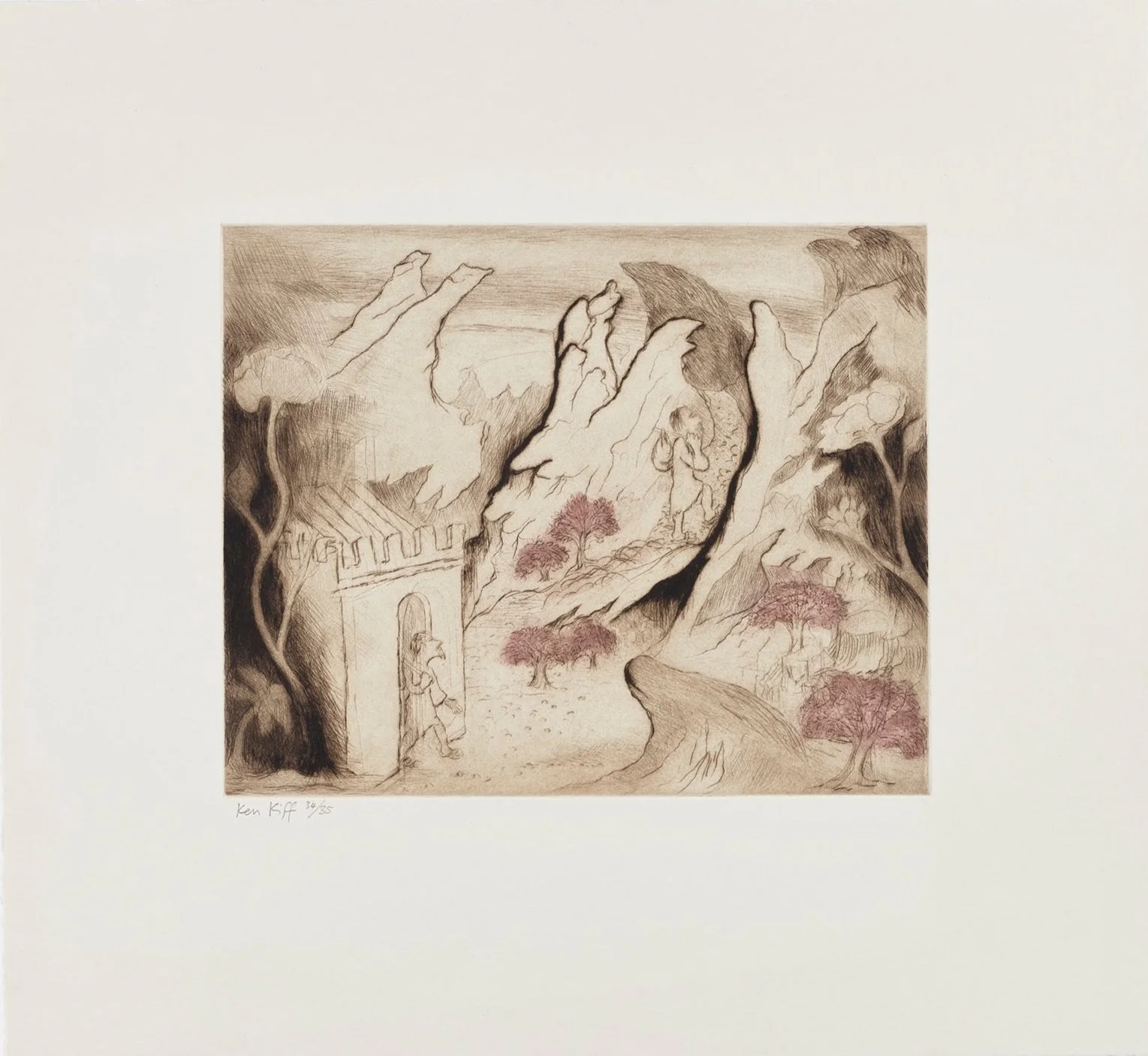
After Giovanni di Paolo, 1993
drypoint, proofed and printed with Studio Prints, London
edition of 35 + 10 APs
sheet 48 x 52.2 cm / image 26 x 32 cm
Lloyd E093.1
£1,500 + vat (unframed)
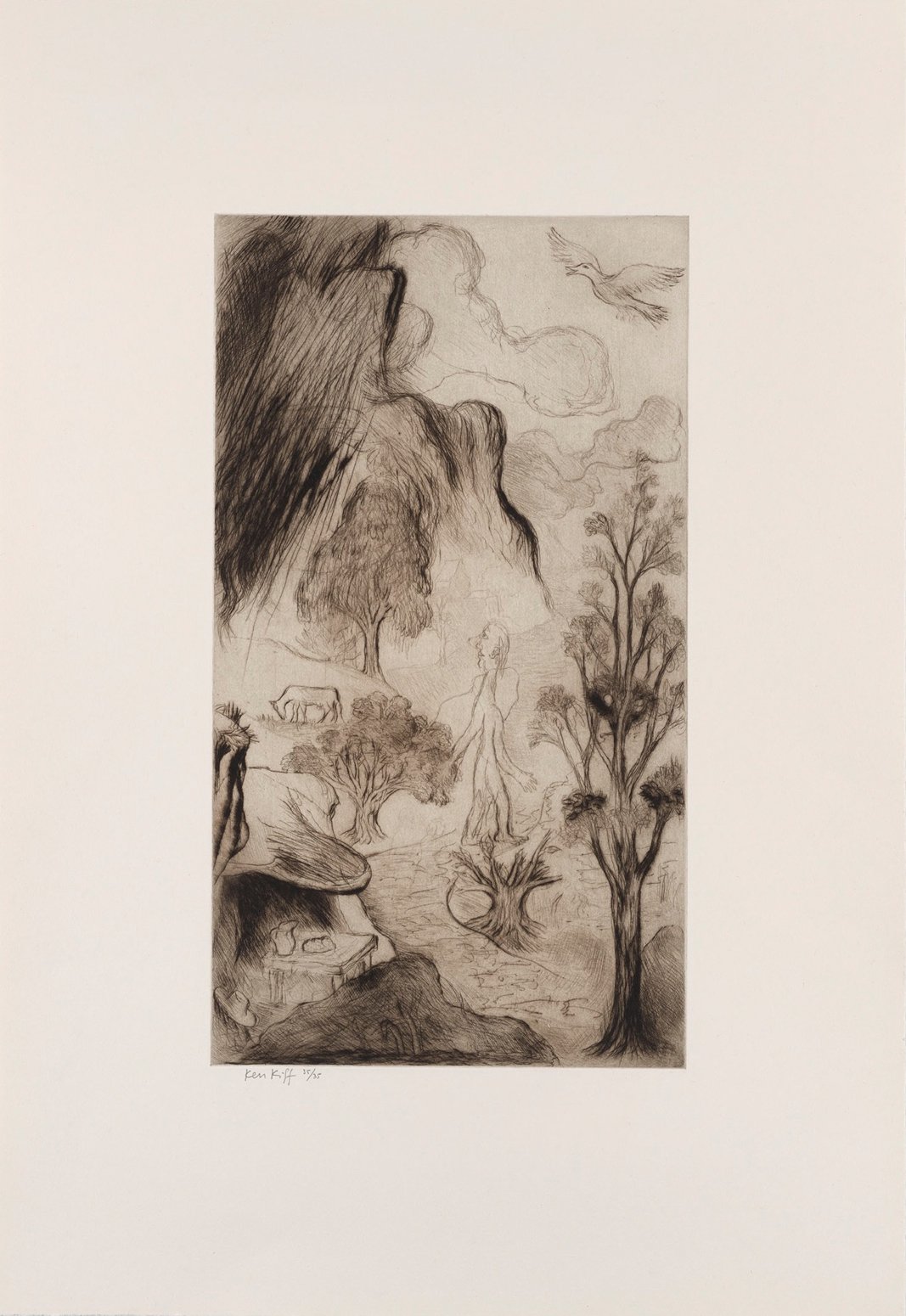
After Patenier, 1993
drypoint, proofed and printed with Studio Prints, London
edition of 35 + 10 APs
sheet 72 x 49.5 cm / image 46.5 x 26 cm
Lloyd E093.2
£1,750 + vat (unframed)
“Kiff was far from a neglected figure during his later career - witness, for example, the two years he spent in 1992 and 1993 as an ‘associate artist’ at The National Gallery, London, during which he produced prints such as After Giovanni di Paolo and After Patenier. And yet, even at this time, he did not occupy a central position in the cultural firmament, and the full scope and ramifications of his project did not receive their proper due. How to account for this? One reason is that the closing decades of the twentieth century was a period still broadly beholden to a (very Western, indeed very male) model of art’s history as a linear, quasi-Darwinian progression of stylistic and discursive artistic positions towards some implied yet never stated end, into which it was difficult to fit his highly idiosyncratic, quietly radical practice. In the third decade of the twenty-first century, a more plural, polyvocal understanding of what matters in art abides. We might hesitate to say that Kiff was addressing his work not to his own moment, but to the future. Nevertheless, today it feels easier than ever to meet him on his own terms.”
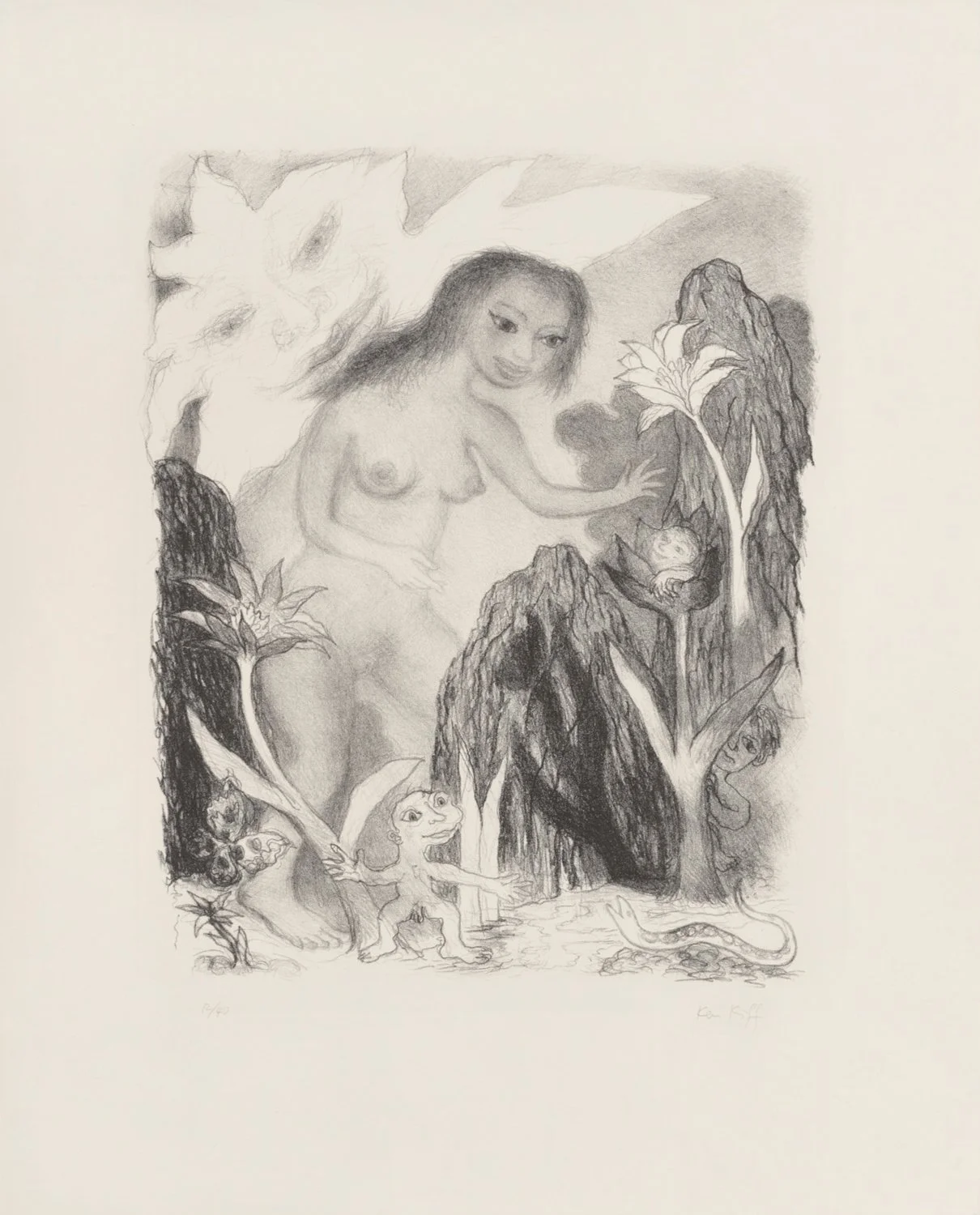
Girl and Rocks, 1991
lithograph, proofed and printed with Erik Holgersson, Gothenburg
edition of 40, of which only 12 signed and numbered
sheet 74 x 60 cm / image 50.5 x 40 cm
Lloyd L091.2
£2,500 + vat (unframed)
“Consider [Kiff’s] description of the emergence of a recognisably human head in one of his paintings: ‘I can only think of saying that the “music” of the painting has kind of firmed up at that point into a particular key, or concentration of themes; that each colour, form, edge or whatever will be speaking, and so at that point the speaking is coming right up into the concentrated form of a head.’ This, very clearly, is not how a graphic, black and white motif such as the dryadic female nude in his lithograph Girl and Rocks came into being. Printmaking, then, demanded that Kiff develop an ear for a different type of ‘music’. To this end, he studied the artists he regarded as masters of the medium. His diaries record his enthusiastic encounters with Paul Gauguin’s woodcuts ‘the most striking thing I could possibly hope to see’ and Marc Chagall’s drypoints ‘aren’t these some of the best prints by any artist ever?’”
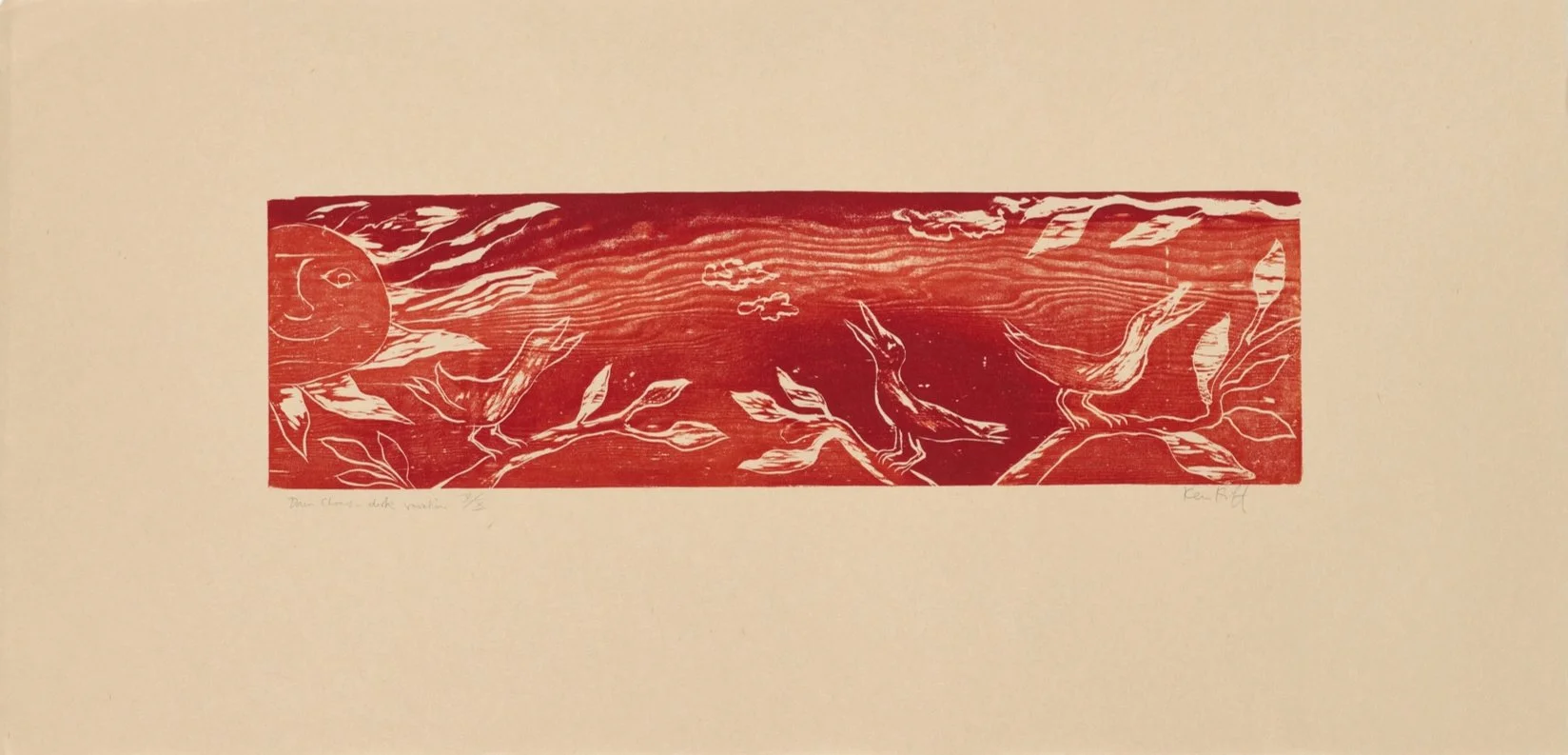
Dawn Chorus - Dark Variation, 1988-90
woodcut, proofed and printed with Jo Briggs, London
edition of 10 + 3 APs
sheet 43.5 x 89 cm / image 16.5 x 58.5 cm
Lloyd W090.1a
£4,500 + vat (unframed)
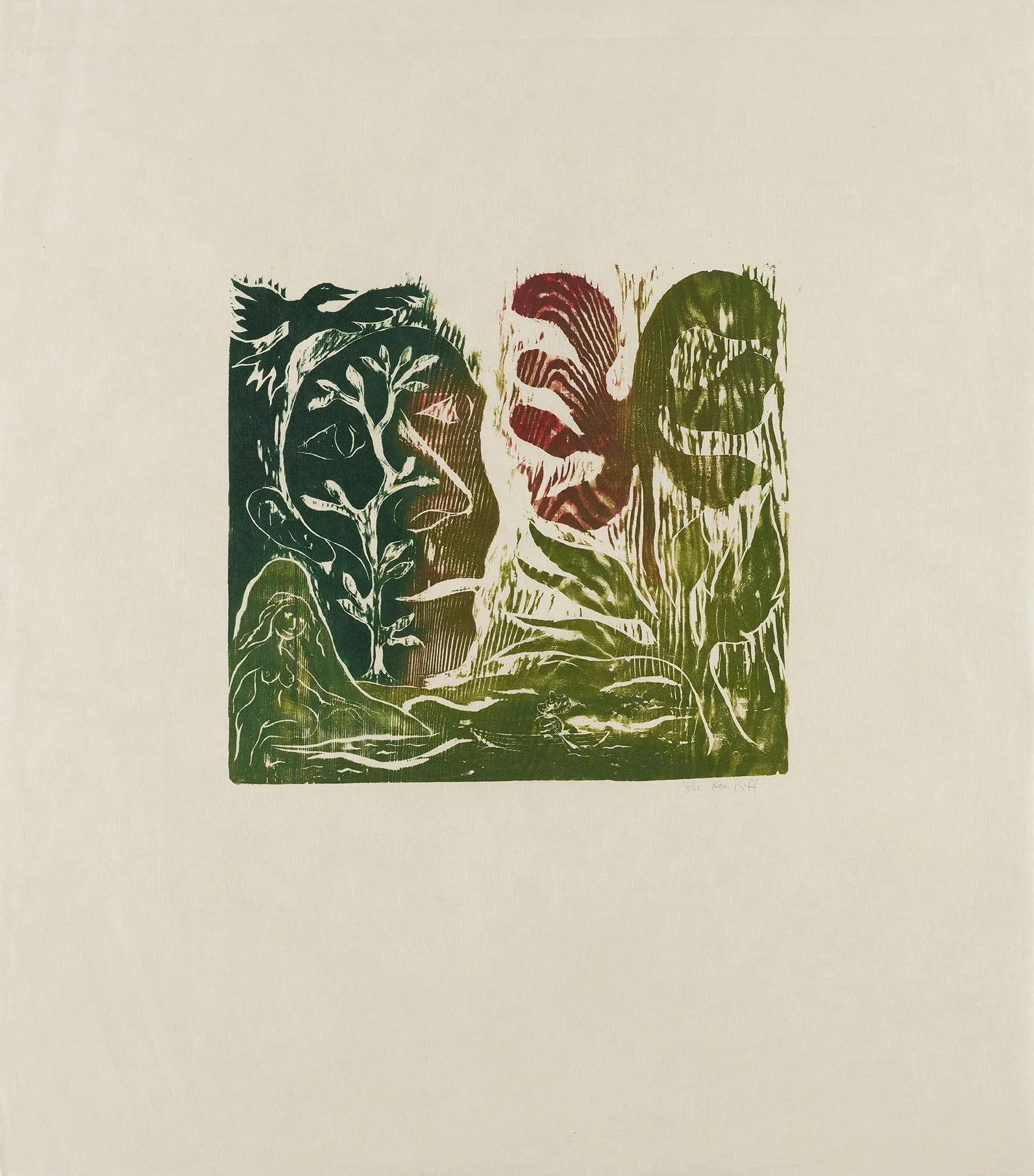
“Another way Kiff tuned into the ‘music’ of printmaking was by attending to the medium’s inherent emphasis on unity - the meeting of ground and image, plate and press. Perhaps the most obvious examples of this are his woodcuts, such as Green Flower and the superlatively vibrant Dawn Chorus – Dark Variation. In the latter work, a trio of birds perch atop leafy branches and greet the rising sun with a song, while behind them the horizon line appears to haze and warp in the heat of the new day, a pictorial effect created not by the artist’s hand, but by the grain of his woodblock. Looking at this, our minds turn to the tree from which the woodblock was fashioned - its daily growth, nourished by sunlight, from seedling to maturity; the slow, unconscious formation of its particular internal contours, in which Kiff would one day glimpse a shimmering vista, and populate it with birds, whose voices join together in harmony to hymn the ongoing world. The artist, here, is in communion with his medium (in a diary entry from 1980, he approvingly notes Munataka’s observation that ‘the artist depends more on the woodblock than on himself’), but also with something much bigger. We might call it nature, but we might also call it ‘wholeness’ — that great, guiding ‘unknown’.”
Green Flower, 1991
woodcut, proofed and printed with Jo Briggs, London
edition of 35 + 5 APs
sheet 76 x 65 cm / image 32.5 x 35 cm
Lloyd W091.1
£3,500 + vat (unframed)
“In Kiff’s drypoint and roulette work A Step and A Boat Among Changing Forms, a female figure navigates a small sailing craft between what the artist memorably described as ‘blobs, reaching out into pale emptiness, but full of things: roots, butterfly, snake, stones, (top bit), man, raindrops etc. etc. All sort of flowing.’ This print’s central motif and composition echoes those of his earlier lithograph Untitled [L089.1], but here Kiff explores the malleability of form to the point of abstraction, and in so doing accesses a pictorial fluidity that comes close to matching - but is importantly distinct from — that of his paintings.”

A Step and a Boat Among Changing Forms, 1994
drypoint and roulette, proofed and printed with Studio Prints, London
edition of 35 + 10 APs
sheet 71 x 54.5 cm / image 41.5 x 31 cm
Lloyd E094.1
£1,750 + vat (unframed)
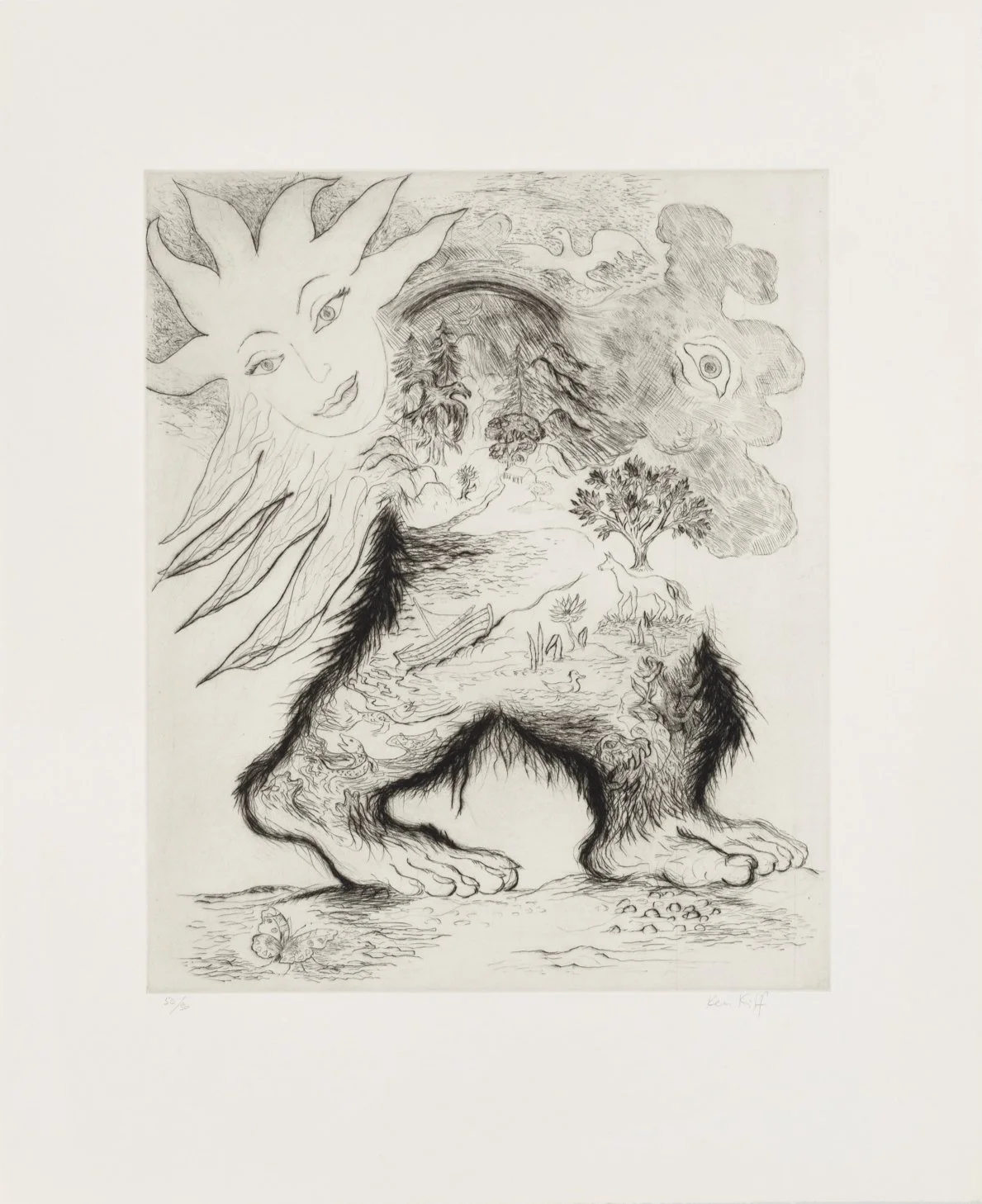
“Consider his drypoint Man Walking, in which the outline of a lone male’s lower body - so shaggy and apelike that it might belong to an early hominid - contains a landscape. Here we see a river teeming with fish, and a little fishing boat drawn up on to a bank. In the distance, a cottage shelters in a mountain valley, above which a white bird flies towards the sun, whose smiling, feminine face dispels a storm and replaces it with a rainbow. It is a work about the needs each of us carry within ourselves, and how these are met by something much bigger than we are: the fathomless universe.”
Man Walking, 1991
drypoint, proofed and printed with Studio Prints, London
edition of 50 + 10 APs
sheet 63 x 52 cm / image 43 x 35.5 cm
Lloyd E091.1
£1,500 + vat (unframed)
“In Kiff’s etching and drypoint Man Drawing at Entrance to a Cave, the titular figure squats at a cave mouth, a location that in Plato’s thought functioned as the threshold between the realm of representation and the realm of the real. He is, it seems, an artist, engaged in drawing the snake we see on the stony ground a few inches from his right foot. Although he is training all his concentration on this reptile, he’s finding it difficult to capture its precise form - witness the discrepancy between the supple line of the snake, and his own unhappy scrawl. Is he simply a poor draftsman, or is the reptile (careless of its obligations as a life model) refusing to keep still? Given that Kiff’s print is a static image, this is something we shall never know. Time, here, is suspended, and the workings of cause and effect may be guessed at, but never truly ascertained.”
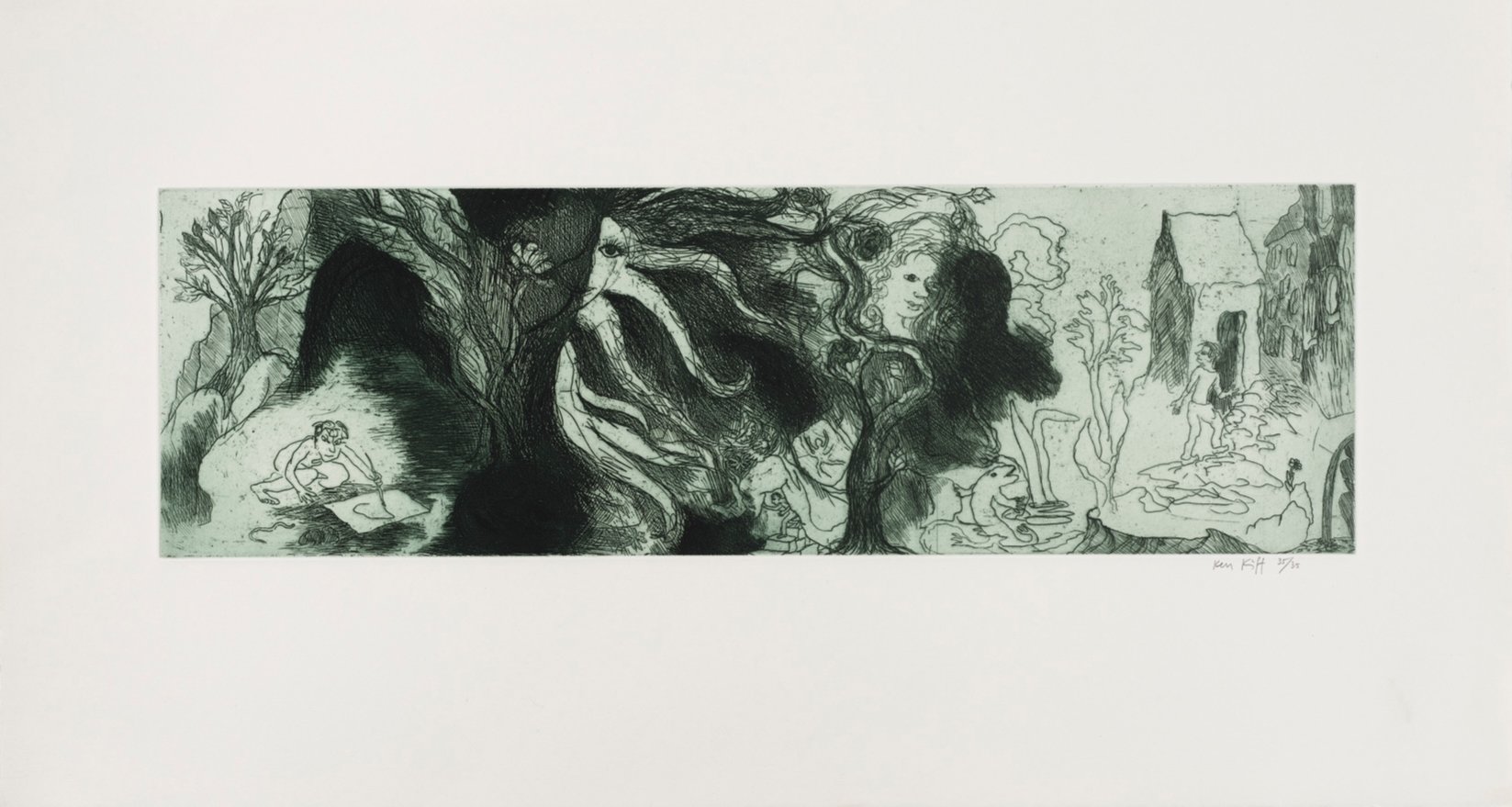
Man Drawing at Entrance to a Cave, 1995
etching and drypoint, proofed and printed with Studio Prints, London
edition of 35 + 10 Aps
sheet 41 x 75.5 cm / image 18.3 x 59.5 cm
Lloyd E095.1
£1,750 + vat (unframed)